Tuesday, January 22, 2013

EDGE.sound Bluetooth Speaker Review


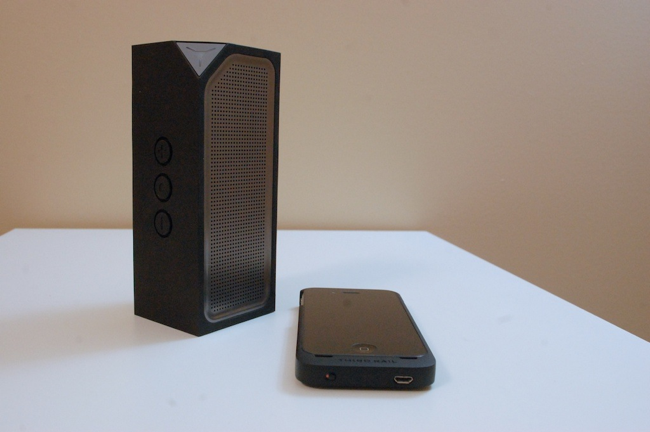
For the last few weeks I’ve been using the EDGE.sound alongside my iPad mini to provide music in my living room, while I work and cook. The tiny Bluetooth speaker is loud enough to fill the room with the sounds of music and podcasts, and I love how I can place the EDGE.sound anywhere I like, because it’s wireless.

The setup was painless. The rear end of the speaker has an on/off switch, and along the top are a set of volume buttons and a single button for pairing. After a quick flip of the power switch and a few seconds of holding the pairing button, I was ready to pair the speaker with my iPad. I’ve had to do that only once, and the two devices have been intelligent enough to automatically reconnect ever since.

As mentioned earlier, the EDGE.sound is easily powerful enough to fill a room with tunes, although the audio quality does seem to suffer from compromises made to achieve the tiny form factor. Vocals are quite clear, but instrumentals tend to feel like they take a back seat during playback, and bass can sound quite tinny (especially if you’re used to speakers with some sort of woofer). But, to be perfectly honest, that tends to matter a lot less after becoming accustomed to how easy the EDGE.sound makes portable music playback. The speaker weighs next to nothing, lasts for three or four days of use, and makes for a good little gaming speaker in a pinch. I’ve also been using the 3.5mm aux-in built into the back of the device to turn the EDGE.sound into a makeshift desktop PC speaker for playing Battlefield 3 and Counter-Strike: GO.

It’s really only when it comes to using the EDGE.sound as a speakerphone that it disappoints. I’ve had issues getting it to pick my voice up properly for Siri commands, and the calling experience simply has not been very good.

Surprisingly, however, that’s quite alright. The main strength of the EDGE.sound is the flexibility afforded by its size, excellent Bluetooth connection, and auxiliary port. It makes for a decent set of wired speaker when you need one, it pairs quickly and reliably with my iPad mini over Bluetooth (with very few drops), and it has enough battery to last for days. It isn’t quite as sturdy or as sharp-looking as a Jawbone Jambox, but the $150 EDGE.sound is still an interesting offering in the growing market of postable wireless speakers — and it has the benefit of being one of the more affordable options, to boot.

Source : http://isource.com/
Read more »

Man who broke into Steve Jobs' home gets seven year prison sentence


Man who broke into Steve Jobs' home gets seven year prison sentenceKariem McFarlin, the man who burglarized the home of the late Steve Jobs back in July has been sentenced to 7 years in a California state prison for stealing over $60,000 in items from the Jobs' home as well as technology and jewelry from homes in other surrounding areas.

35 year old McFarlin was arrested back in August after Apple and REACT (Rapid Enforcement Allied Computer Team) were able to track iTunes purchases to serial numbers of devices that were owned the Jobs family. He admitted to the crimes as well as additional robberies.

McFarlin admitted to the burglary under questioning by Palo Alto police and said he had stolen from other homes in the San Francisco Bay Area, including two homes in Marin County, four homes in San Francisco County and one home in Alameda County.

He admitted keeping hundreds of thousands of dollars' worth of property from those burglaries at his home and at a storage locker. The property included computers, jewelry, furniture and a solid silver bar, according to the Santa Clara District Attorney's office.

At the time of his arrest, McFarlin stated that he had done it due to money issues. Aside from his prison sentence of 7 years, he's also been ordered to pay restitution to the families that were stolen from.

Source : http://www.imore.com/
Read more »

Deal of the Day: 42% off Seidio CONVERT Combo for iPhone 5


Deal of the DayToday Only: Pick up the Seidio CONVERT Combo for iPhone 5 and save $20.95!

Eliminate the need for two different cases with this CONVERT Combo. Put on the first layer, the Surface case, when using your iPhone 5 everyday. When you're in tough or rugged conditions put on the Rugged Skin and Skeleton and securely hold your device wherever you go with the Seidio locking Holster. When you don't need the extra protection, simply remove the Rugged Skin and Skeleton! Color options include black and sand gray.

List Price: $49.95     Today Only: $29.00

Source : http://www.imore.com/
Read more »

Saturday, January 19, 2013

iPad mini Smart Cover Review


I bought a red Smart Cover to go with my slate iPad mini. I would have preferred leather, but polyurethane was the only choice this time around. The design isn’t quite as classy as its full-sized alternative on the 9.7″ iPad because it lacks the metal magnetic latch, but it still compliments the sharp design of the iPad mini.

The red absolutely dominates the face of my iPad mini while the cover is on, leaving only glints of dark aluminum underneath. The cover is still easy and fun to fold into a triangular stand, or simply fold behind the iPad mini so that you can safely rest the device on a table. When tucked underneath the mini, the Smart Cover provides a very sexy red outline to the slate device. The bright red really contrasts the black and slate design.

I’m still on the fence as to whether the red is too bright. I bought the slate version partly because I thought it would prove to be a lower profile device in public, but the red on the Smart Cover just screams. On the bright side, the red does make the cover harder to misplace.

Three Panels, Not Four

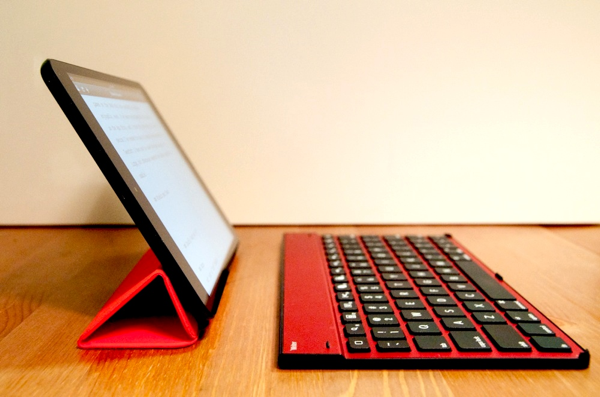
Where the mini Smart Cover shows great improvement is as an upright stand for writing (with a Bluetooth keyboard) and viewing. The original Smart Cover was far too close to 90 degrees to be of much use to me for typing, but this Smart Cover is much closer to 60 or 70 degrees. This means that it’s much more comfortable to sit in front of and type.

The downsides to the new design have to do with the magnets and the reduced number of panels. The magnets no longer align flawlessly every time, which admittedly takes away from some of the magic of the product. This smaller cover also features only three panels, as opposed to the four on the original Smart Cover, meaning that the resulting triangular stand is less stable than it was before. Instead of really tucking into itself to form a solid base, the Smart Cover simply attaches to itself – similar to pressing all of your fingertips together. The fit of the Smart Cover is still secure, but not as rock-solid as it was in its previous incarnation.

Conclusion

The $45 Smart Cover for iPad mini isn’t cheap – it’s actually quite pricey, considering the materials and construction. However, if my last Smart Cover was any indication, it should last quite a while.

I also feel a strange sense of affection for this moulded plastic accessory. It’s thin, light, and simple. It protects my screen during storage, folds effortlessly into a typing or viewing stand, and detaches with a quick tug. If you liked the original Smart Cover, then you’ll like this one. Furthermore, if you were bugged by the restrictive viewing angle on the original, then you’ll love this newer design.

The Smart Cover was purchased by the author of this post for review on iSource. For further information regarding our site’s review policies, please see the “About” page.

Source : http://isource.com/
Read more »

Never mind iPhone 6 and iPads next, in 2013 it's all about iOS 7 and iCloud


Never mind iPhone 6 and iPads next, in 2013 it's iOS 7 and iCloud that matter mostThere'll be an iPhone 5S and iPhone 6. There'll be a Retina iPad mini. There'll be a thinner, lighter iPad 5. There'll be an Apple A7 system-on-a-chip. There'll be an LTE radio that can do simultaneous voice and data, and eventually voice over LTE. There may be curved displays, biometric sensors and security, 4K AirPlay, onboard voice parsing, in-air gesture and face recognition, and much, much more. Apple's hardware will continue to tick tock its way towards the future, but for mainstream users, most of the time, the devices we hold in our hands today are more than good enough. And it's the stuff inside and around them that's become far, far more important.

iOS 6 was prep work, a way for Apple to get Google off their platform, fully outsource social, and better approach China. It prepared Apple for the future, but it didn't take them there. Likewise, iOS 5 introduced iCloud and Siri, but to this day Apple's online services are still unreliable, with the potential of tomorrow but mired in the problems of yesterday.

When BlackBerry 10 launches at the end of this month, iOS will bebome the oldest major operation system in mobile. Windows Phone still hasn't found feature parity or market traction, but Microsoft can throw Windows and Office money at it in perpetuity, and their phone division is perhaps the only part of the company that has shown any real, transformative forward thinking. They'll get there. Android still hasn't caught up on interface or overall experience, but their feature set has leap-frogged ahead, and Samsung is now interesting and competitive all on their own. Then there's Amazon, Facebook, Intel, NVIDIA, and who knows what else 2013 will bring.

All of them will throw more and more varied hardware, more often, at the market than Apple. But it's not Samsung's or LG's or HTC's or Nokia's or BlackBerry's hardware that Apple will face in the market. It's Google Now and BlackBerry Balance and whatever Facebook does with their social graph, and SDKs that let developers create compelling apps to leverage them.

It's not about outdated concepts like widgets or settings toggles, or inconsequential interface trends like skeuomorphism. it's about software and services that don't force us to hunt for data or controls, no matter how they're painted up, but that bring data and controls to us, flat or textured. It's about actionable notifications powered by headless apps and seamless inter-app communication. It's about predictive data assistance with multi-layer natural language interfaces. It's about data moving from cloud to device, or vice versa, transparently, in the background, so we have what we need, when and where we need it, without having to manage or store it. It's about all our stuff working together directly, device to device, so using one of them is akin to using any one of them. It's about an app ecosystem that pushes rather than than waits for us to pull, with demos and refunds, and analytics that delight developers and users alike. It's about the brilliant interaction of software and services both on-device and in the clouds.

Over the coming weeks and months, we're going to be seeing a ton of rumors and leaks, real and fake, about the new iPhones and iPads and other devices Apple is thinking about for this spring and fall. None of them will be as important to Apple, to us, or to the future of Apple's mobile platforms as iOS 7 and iCloud this summer.

Source : http://www.imore.com/
Read more »

Thursday, January 17, 2013

Cord-cutting's moment is now, and Apple is missing it


I knew that cord-cutting’s time had come when I visited my wife’s parents in Arkansas over the New Year’s holiday. My father-in-law has always been one of the techiest people I know—he’s got a giant flat-screen high-definition television connected to a killer stereo system, making his home theater experience feel quite a bit like an actual theater.

Roku offers more than 700 viewing options.

On this visit, however, his cable box was gone: It had been replaced by a Roku, and the cable service replaced by subscriptions to Netflix, Hulu Plus, and Amazon Prime. That works out to a savings of at least $30 a month—well worth it, my father-in-law says, even though he can’t watch CBS shows or live golf anymore. Instead, he’s been exploring the Criterion Collection on Hulu Plus.

“The quality is as good as cable and satellite and in some programming areas better,” he told me last week. He gushed: “Hulu Criterion is a treasure vault.”

So it was no surprise, then, when Paid Content ran this chart last week, revealing that the number of cable subscribers declined for the “first time in history,” down from 100.9 million in 2011 to 100.8 million in 2012. That’s a minor dip, in the scheme of things, but also portentious.

It’s one thing when youngish people in their 20s and 30s decide to leave cable behind—my wife and I cut the cord after Hulu first appeared and while Netflix’s streaming service was still loaded mostly with second-tier movies from the 1970s. But it’s another thing entirely when you start losing people in their 50s and 60s: To the extent that the newspaper industry has survived, it’s because older readers have stuck with print-reading habits formed in their youth; it’s possible that the cable industry won’t be able to depend on baby boomers to quite the same extent.

And here’s a shocker: Apple—which has anticipated this very moment for so long—still doesn’t seem quite ready for it.

Apple’s fallen far from the cord-cutting tree

Yes, the Apple TV has been around since 2006. And yes, the Apple TV has slowly grown its sales during that time. And yes again: Apple CEO Tim Cook recently upgraded the Apple TV’s role in the company from a “hobby” product to an area of “intense interest.” The truth is: It still doesn’t feel like there’s much there there.

Apple TV’s lineup isn’t exactly overwhelming.

Cost is a big reason viewers cut the cord: It’s cheaper to subscribe to a few video services online than it is to pay for the entirety of offerings on cable television. But for many people, cost effectiveness is the point: Viewers have long fantasized about an “à la carte” version of cable that would let them subscribe to ESPN, say, without having to also pay for Lifetime. The economics of cable haven’t really let that option emerge. The closest thing? Online video on demand services like Netflix and Hulu Plus—which not only let you choose when you want to watch, but also effectively let you control the range of content you regularly choose from.

And Roku, at the moment, seems far better positioned to offer a variety of choices. What’s more, it seems like it’s more interested in offering a variety of choices.

For example: Last week, Roku announced a deal with Time Warner Cable that will let the cable company’s subscribers stream up to 300 live channels through through Roku box. And Roku also added several new channels—including Fox Now, PBS, and PBS kids—to its 700-channel lineup.

Meanwhile, the last big content news for the Apple TV came five months ago, when Apple (somewhat belatedly) added Hulu Plus to its much more limited channel lineup. And the Apple TV can’t stream content from Amazon Instant Video, HBO Go, or numerous other services that Roku offers.

Apple’s between a Roku and a hard place

The message is clear: If you want the service that’s more adept at providing a variety of viewing options, you go with Roku. If you want the company that looks for all the world like it’s working to bring you the best variety of viewing options a year from now, you go with … Roku. The thing that the Apple TV has going for it? It doesn’t seem nearly as lame as Google TV, but that assessment may depend entirely on your point of view.

This isn’t entirely Apple’s fault: The company is still wading through the weeds of legacy media companies that don’t want to change to meet the expectations of 21st century viewers. And maybe we’re spoiled: We saw Apple getting its way in the music sector and expected more of the same in other media—though books, like video, have proven a tougher nut to crack for the company. All of this could change overnight, though, if Apple suddenly signed a few deals with video providers and started really competing.

The problem is that there’s already a company out there meeting viewer expectations, and doing it at the point when even my parents-in-law are ready to make the leap into a new way of watching TV. For the first time in a decade, it’s not Apple leading the way. Who can blame viewers who make the Roku choice?

Source : http://www.macworld.com/
Read more »

Finish for iPhone aims to help even procrastinators get their stuff done


I've joked that to-do apps are like gym memberships -- something people throw money at out of guilt and good intentions, but seldom follow through on using. Finish by Basil, just released for the iPhone, aims to to help with that through a combination of good design and the understanding that failure often is an option. In fact, Finish is crafted precisely with procrastinators in mind.

Here's the gist. You create a to-do -- name it, date it, and done -- and assign it to a time period that's sorted into short term, mid term, or long term. As time passes, the tasks automagically re-sort accordingly. If you don't get it done on time, rather than make you feel like complete jerk, it just moves it to the next appropriate time frame and subtly urges you to boot yourself in the butt and get it done already.

Basil has done a lot to de-stress the to-do experience as well, keeping long, intimidating lists out of sight until they really need to be in mind, and letting you choose a notification level that bests suits your temperament. Whether you're easily distracted or truly overwhelmed, time-frame based tasking might be just what you need.

Controls are gesture based for the most part, but they're well hinted -- sometimes too well hinted, with expository text that lingers long after you get the hang of it -- and there are buttons where there should be, so you can spend your time using instead of figuring out how to use.

It's iPhone only, so multi-device users and power sync-ers take note. But if all you're looking for is an elegant, thoughtful, realistic way to manage your tasks, give Finish a look. And if you've tried it already, add your thoughts in the comments.

Source : http://www.imore.com/
Read more »

AT&T expands FaceTime over cellular support


At long last—after considerable customer criticism—AT&T said Wednesday it will let even more customers use the FaceTime video chatting service over its cellular networks. Mark Collins, the company’s senior vice president of voice and data products, made the announcement in a blog post. “As a result of ongoing testing, we’re announcing AT&T will enable FaceTime over Cellular at no extra charge for customers with any tiered data plan using a compatible iOS device.”

Previously, FaceTime over cellular was available to customers with the company’s “Mobile Share” plan, or those with an LTE device (like the iPhone 5) on the company’s tiered plans. Wednesday’s announcement benefits those customers using the iPhone 4S.

But those customers may have to wait yet. Collins said that the rollout of the service “will be applied automatically over the next few months.” He didn’t indicate which regions might receive the service first, nor which ones will have to wait to the end of that period. AT&T took a similar approach when it started rolling out FaceTime over cellular to its LTE customers last fall.

AT&T spent much of the previous year rebuffing criticism from customers and net neutrality groups about its slow rollout of FaceTime over cellular, even though it had seemingly hastened the process.

Now, Collins said, AT&T is assured the service won’t overwhelm its data networks. “We wanted to roll it out gradually,” he said, “to ensure the service had minimal impact on the mobile experience for all of our customers.”

Sprint and Verizon both already offered all iPhone customers the ability to place FaceTime calls over their cellular networks.

Source : http://www.macworld.com/
Read more »

Judge orders Apple, Amazon to settlement talks on App Store dispute


A federal judge in California has ordered Apple and Amazon.com to sit down and attempt to settle a lawsuit between them over Amazon’s use of the “Appstore” name for its online application marketplace.

U.S. District Court Judge Elizabeth Laporte told both parties on Tuesday that they must attempt to reach a settlement ahead of their next scheduled appearance in court on March 21.

Apple sued Amazon.com on March 18, 2011, over use of the “Appstore” name, just four days before Amazon launched its “Appstore for Android.”

Apple had previously requested Amazon.com not use the name, which Apple contends is too similar to its own “App Store” for iOS applications. Apple launched its App Store in 2008.

Laporte told each company to deliver to her a confidential settlement conference statement by March 11. The statements should spell out claims and defenses, a summary of the case, costs incurred and details on what each party is seeking, she said.

The statement should also include “the party’s position on settlement, including present demands and offers and a history of past settlement discussions.”

The documents from both sides will be delivered directly to the judge and won’t be lodged with the court clerk or the opposing parties, Laporte instructed.

“If there have been no prior settlement discussions, plaintiff must serve a demand letter outlining its theories for recovery, supporting facts and damages in writing at least 7 business days before the conference, and defendant must respond in writing at least 3 days before the conference,” Laporte wrote.

“It is not unusual for conferences to last several hours or at times, all day,” Laporte wrote. “No participant in the settlement conference will be permitted to leave the settlement conference before it is concluded without the permission of the judge.”

Apple alleges six causes of action for the lawsuit: trademark infringement and dilution under the Lanham Act, common law trademark infringement, dilution under the California Business and Professions Code, unfair competition and false advertising.

Earlier in January, Amazon won a favorable ruling on one of Apple’s complaints when U.S. District Court Judge Phyllis J. Hamilton ruled that Amazon did not mislead consumers by using the “Appstore” name.

Hamilton said use of the “Appstore” name for an online application store did not necessarily mean the store was of the same nature and offered the same quality as Apple’s App Store.

“Apple has failed to establish that Amazon made any false statement (express or implied) of fact that actually deceived or had the tendency to deceive a substantial segment of its audience,” Hamilton wrote in her judgment.

The case is Apple vs. Amazon.com, 11-01327, in the U.S. District Court for the Northern District of California.

Source : http://www.macworld.com/
Read more »